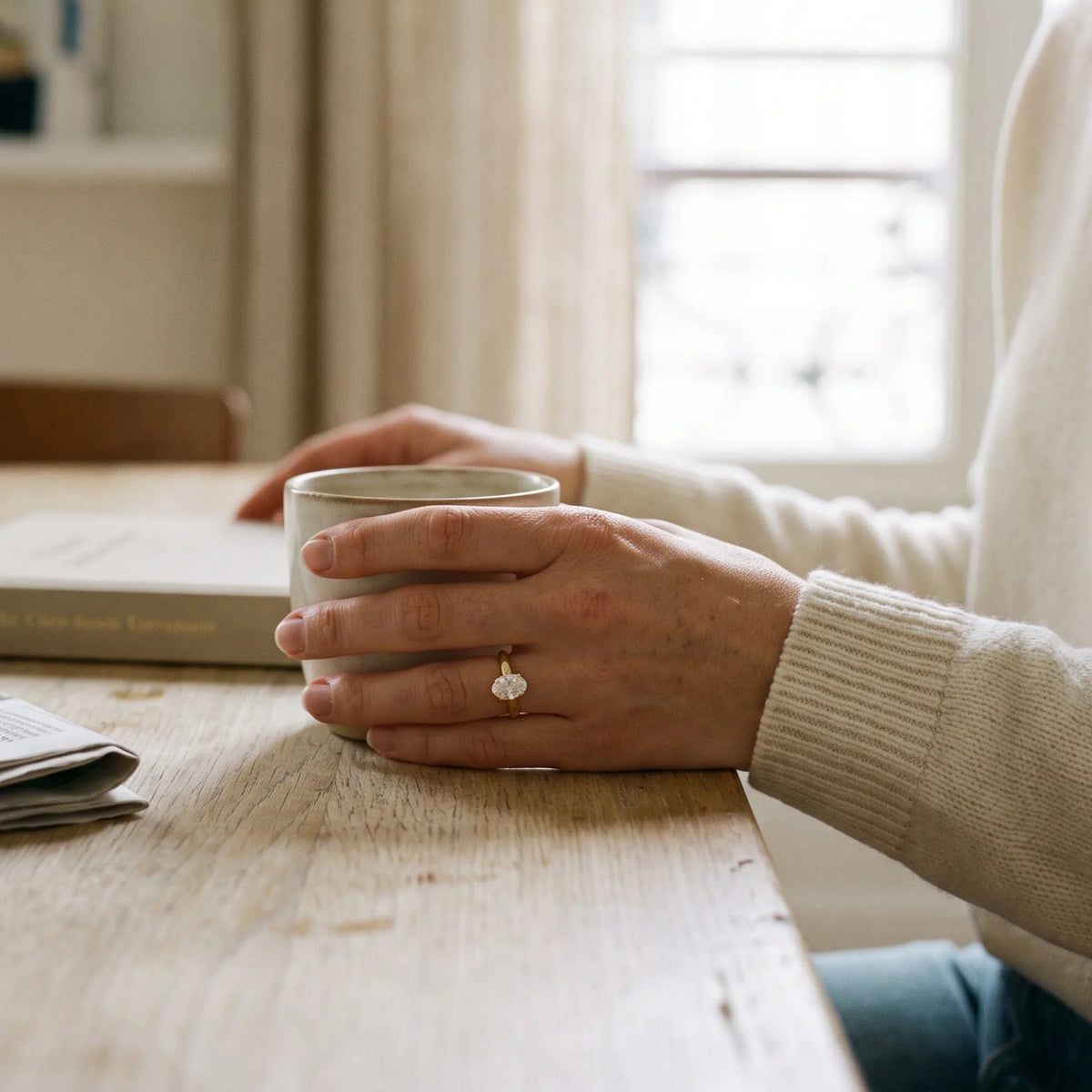

Choosing a ring together
There is a particular kind of pressure around choosing an engagement ring.
Someone is expected to know.
Know her size. Know her taste. Know which diamond she would choose. Know whether she prefers yellow gold or white. Know what she would wear for the rest of her life.
It makes for a good proposal story.
It is not necessarily a good way to choose a ring.
An engagement ring is worn by one, but chosen by two.
Choosing it together does not make the ring less romantic. It can make the choice more precise.
Start with what she already wears
The easiest way to understand someone's jewelry preferences is to look at the jewelry she already owns.
Not the things she has pinned on Pinterest.
The things she actually wears.
Look at the metal.
Yellow gold, white gold, rose gold or a combination.
Look at the scale.
Are the bands slender or substantial? Are the stones small or large?
Look at the shapes.
Clean and geometric? Rounded and soft? Vintage? Almost invisible?
Look at what she wears every day and what she wears only on special occasions.
These details are often more informative than asking, "What kind of engagement ring do you like?"
Most people can identify what they like when they see it.
Fewer can describe it accurately before they do.
Decide how much of the decision belongs to each person
There is no rule that both people must make the choice together.
Some couples make every decision jointly.
Some decide on a budget and general style together, but let one person choose the ring.
Some choose the diamond jointly and then let one person choose the setting.
Some choose a ring first and then make the proposal itself a surprise.
The important thing is not who has the final say, but that everyone understands what is being decided and what is not.
A useful conversation might begin with something as simple as,
"What do you want to wear?"
"What matters most to you?"
"What do you not want?"
"How much should we spend?"
"Do we want the ring to be a surprise?"
There is no romance to be gained by pretending these questions don't exist.
Set the budget before falling in love with the ring
This is one area where sentimentality can turn into something expensive very quickly.
Set a realistic budget before spending hours deciding on a ring.
There is no objective engagement-ring budget that applies to every couple, but salary formulas are marketing fiction that few couples can actually afford.
Set a budget that works for your finances.
Once that number is set it becomes easier to make other decisions.
Perhaps the diamond is most important.
Perhaps the setting matters more.
Perhaps a particular shape is non-negotiable.
Perhaps the most important consideration is a ring that will actually be worn.
A budget does not make the process less romantic.
It makes the process more precise.
Choose the diamond by appearance, not the number alone
Carat weight is simple to understand.
That is why it often dominates the conversation.
A bigger number equals a bigger diamond.
A bigger budget equals a bigger carat weight.
That is why carat weight can become the deciding factor in a ring's appeal.
It is also why carat weight can be misleading.
Two diamonds with the same carat weight can look very different.
Two diamonds with similar grades can look very different.
The specifications are important because they describe the diamond.
The eye is important because the ring will ultimately be seen, not read.
Try different shapes on the hand
A diamond shape can look very different once it is on the hand.
An elongated oval can make the finger look longer.
A round brilliant has a different presence than an emerald.
A cushion can feel heavier than a marquise.
A pear or marquise can create directional emphasis.
These are all general observations.
They should not be definitive.
Trying different shapes is more useful than deciding based on what looks good in a screen.
The right question to ask is not which shape is popular, but which proportion feels right on the hand.
Decide on the setting
The setting is what makes a diamond into a ring.
A solitaire creates the most visual space around the center stone.
A three-stone design creates a different composition.
A halo creates another presence.
A bezel creates a more enclosed appearance.
Pavé creates another surface quality.
The choice also dictates how low or high the ring will sit, how secure it will be, how easily it can be cleaned and how it will interact with a wedding band.
This is why the setting should not be an afterthought.
It is part of the object, not an accessory to it.
Consider the wedding band now
The engagement ring is not a permanent object.
At some point there will be another ring next to it.
That does not mean the rings have to be purchased as a set.
It does mean that it is worth considering how they will interact.
Will the engagement ring sit comfortably next to a straight band?
Does its setting allow for enough space?
Would a shaped band be a better choice?
Will the difference in metal be distracting?
Does she want to wear them together at all?
There is no requirement that the rings match.
There is only a requirement that the combination makes sense to the person wearing them.
Talk about the way she actually lives
This is rarely discussed, but an engagement ring is not something that is worn in a salon.
It is worn at work.
It is worn on vacation.
It is worn in the shower, and on the kitchen counter, and in the laundry room, and at the computer, and the gym and the grocery store.
It may be worn constantly, or worn only on weekends or only on holidays.
It may be worn while exercising, or sleeping, or travelling, or eating.
It may be worn at the office or taken off when entering a restaurant.
The choice of setting and construction should reflect that.
A ring that is meant to be worn constantly should be physically suited to the task.
Beauty is not enough.
The object has to function.
Ring size should be a conversation, not a guess
If the ring is being chosen together, there is no reason to make sizing a mystery.
Measure the intended finger.
A ring that fits well can serve as a useful reference. Interior diameter is particularly informative because it indicates the actual opening of the ring.
For Alva's sizing, the millimeter measurement is the underlying reference with US/Canada sizes mapped to interior diameter and circumference in the house sizing table.
If there is uncertainty, it should be resolved before the ring is made.
Guessing is not romantic.
It is just imprecise.
The surprise can be somewhere else
Choosing the ring together does not mean the proposal itself has to be predictable.
The ring can be known.
The moment can still be private.
The location can be a surprise.
The words can be unexpected.
The timing can be secret.
The ring does not have to carry the weight of the proposal.
In fact, removing that weight can make the moment more personal.
The surprise is not the object.
It is the life being proposed.
And then stop comparing
There comes a point when research stops being productive.
Another diamond.
Another setting.
Another jeweler.
Another price comparison.
Another tab open on the browser.
The engagement-ring market is very good at convincing people that the next ring might be the right one.
Eventually, you have enough information.
The decision becomes less about finding the objectively perfect ring and more about choosing the one that fits the person, the budget and the life.
That is enough.
A ring chosen together can still become hers
The final ring may have been chosen by two people.
It may have been tried on by two people.
The diamond may have been chosen jointly.
The budget may have been chosen jointly.
And yet, once it is on her hand it becomes something else.
It becomes hers.
It acquires scratches.
It becomes familiar.
It appears in photographs without thinking.
It becomes associated with places, and years, and ordinary moments that had nothing to do with the original proposal.
That is when the real magic begins.
Choosing the ring together is not the end of the romance.
It is simply choosing the object carefully enough to let the life afterward do the rest.
The ring can be chosen together. The meaning will always be hers.
Is it okay to choose an engagement ring together?
Yes. Choosing an engagement ring together can make the decision more precise while leaving the proposal itself private or surprising.
Should couples choose the engagement ring together?
There is no single correct approach. Some couples choose the entire ring together; others decide on the budget and direction together while one person makes the final selection.
What should you decide before buying an engagement ring?
The main decisions are budget, ring size, metal, diamond shape, setting, everyday-wear requirements and whether the ring should work with a future wedding band.
Should the engagement ring and wedding band match?
No. Matching is one option. Contrasting metals, shapes or textures can work just as well if the combination is comfortable and intentional.